
LinkedIn thought leadership B2B strategies are among the most underused pipeline channels available today.
Your buyers are on LinkedIn every day reading, forming opinions, deciding who they trust before any sales conversation happens.
That’s the opportunity. Not reach. Not followers. The fact that you can build credibility with exactly the right people, passively, while your outreach and ads are running in parallel.
When it works, every other part of your GTM motion gets easier. Cold emails land differently when the prospect recognises your name. Sales cycles move faster because trust was already building in the background. Referrals come in from people who’ve been reading your content for months without ever commenting.
When it doesn’t work — and it often doesn’t — it’s just content for content’s sake. Posts that get likes from colleagues and generate zero pipeline.
The difference is almost always the same thing: whether your LinkedIn presence is connected to how you actually go to market, or running separately from it.
This guide covers how to build a LinkedIn thought leadership system that connects directly to your GTM motion, speaks to the right buyers, and compounds over time.
What LinkedIn Thought Leadership B2B Actually Means
The term gets misused constantly. Posting motivational quotes is not thought leadership. Sharing company updates is not thought leadership. Going viral with a hot take is not thought leadership.
Thought leadership in B2B means this: you consistently demonstrate that you understand the problems your buyers face better than anyone else — and that you have a clear, defensible point of view on how to solve them.
That’s it.
It doesn’t require a large following. It doesn’t require daily posting. It doesn’t require production value.
It requires depth, consistency, and relevance to a specific audience.
For a B2B company, thought leadership that works is narrow. It speaks directly to a defined ICP. It addresses real problems that audience is actively dealing with. It earns credibility with the people who could become clients — not with the general LinkedIn population.
A post that gets 50 reactions from VPs of Sales at mid-market SaaS companies is worth more than one that gets 2,000 reactions from a random mix of people who will never buy from you.
Why It Belongs Inside Your GTM System
The mistake is treating LinkedIn content as a separate marketing function — something the marketing team manages on a content calendar with no connection to what sales is doing, what outbound is targeting, or what campaigns are running.
When that happens, content generates impressions. It doesn’t generate pipeline.
The version that works is different. LinkedIn content becomes part of the same motion as outreach, ads, and events — all aimed at the same ICP, reinforcing the same message, from different angles.
Here’s what that looks like in practice.
You identify a target segment — let’s say VP of Sales at B2B SaaS companies between 50 and 200 employees going through a scale phase. Your outbound sequences are targeting this segment. Your LinkedIn ads are targeting this segment. And your LinkedIn content is speaking directly to the challenges this segment faces: building an outbound motion for the first time, hiring SDRs without a system, trying to make pipeline predictable during a growth phase.
When someone in that segment receives your cold email, they may have already seen three or four posts from you on topics they actually care about. You’re not a stranger. You’re someone whose thinking they’ve encountered before. The email converts at a higher rate because the trust was already being built passively.
This is what a connected GTM motion looks like — outbound, content, and paid all aimed at the same ICP, reinforcing the same message from different angles. Each one makes the others work harder.
There’s one more dimension worth naming. LinkedIn content is increasingly indexed and surfaced by Google — including Google’s AI Overviews. A post you wrote six months ago about a specific B2B challenge can appear at the top of a search result when a prospect is actively researching that problem. That’s organic visibility you didn’t pay for and didn’t need a separate SEO strategy to capture. For B2B companies in specific niches — SaaS, consulting, AI — this effect is already visible. Search for a niche GTM or sales topic and LinkedIn posts from practitioners regularly appear above traditional blog content. Your LinkedIn presence isn’t just a social channel. It’s becoming part of how buyers find you before they ever visit your website.
The ICP-Aligned Content Strategy
The default approach to a LinkedIn content calendar is built around what a company knows, what it wants to talk about, or what seems to perform well in the feed. The result is content that attracts a general audience rather than a qualified one.
The ICP-aligned approach flips this. You build your content calendar around what your target buyers care about — and you deliberately match your posting topics to the segments you’re actively targeting in outreach and paid.
We ran this with clients and the difference was clear. One client was targeting Head of Marketing at consulting firms with outbound. Their cold email reply rates were decent but the conversations were cold — lots of education needed before the prospect understood why they were talking to us. We shifted their LinkedIn content to focus specifically on demand generation challenges in consulting businesses: how to generate pipeline beyond referrals, how to build a repeatable outbound motion when your sales cycle is relationship-driven, how to measure marketing impact in a professional services context.
Within six weeks the outbound conversations changed. Prospects were referencing posts in calls. The education step shrank because credibility was already established. Pipeline moved faster.
How to build an ICP-aligned content calendar:
Start with your active target segments. For each one, list the top five challenges they’re actively dealing with right now. Not the problems you solve — the problems they’re talking about, searching for, complaining about in conversation.
Map those challenges to content topics. Each topic becomes a content pillar that you return to repeatedly from different angles.
Cross-reference with your outreach and ad messaging. If your outbound email opens with a specific pain point, your LinkedIn content should be addressing that same pain point from a thought leadership angle — not pitching, just showing that you understand it deeply.
Run the same exercise every quarter as your target segments or their challenges shift.
Frameworks and Styles That Actually Work
LinkedIn posts fail for one of two reasons: they say something obvious, or they say something interesting but don’t land the point.
The posts that work — the ones that make a senior buyer stop scrolling — follow a recognisable structure even when the topic changes. Here are the thinking frameworks behind them.
Observation → Insight → Implication
Start with something you’ve noticed in practice. Not a statistic. Not a hot take. A real observation from working in the space. Turn that observation into a non-obvious insight — the thing many miss. Then draw out the implication for the reader.
Example: “SDR time gets eaten by research that never converts into outreach. The problem isn’t the research — it’s that research and outreach are treated as separate activities. When you build a system where research happens automatically before the rep touches a contact, conversion rates go up and ramp time goes down.”
Broken Pattern → Better System
Describe a common approach that doesn’t work. Explain specifically why it breaks. Show what a better system looks like. This works because it validates the reader’s experience (they’ve seen the broken pattern) and gives them something useful.
Contrarian Take
Challenge a widely held belief in your space with evidence and reasoning. Not for the sake of being contrarian — only when you actually disagree and have a defensible position. These posts attract high-quality engagement from people who are thinking seriously about the problem.
The Before / After
A real example — anonymised if needed — showing what a situation looked like before and after a system change. The specificity is what makes it land. Vague outcomes don’t work. Numbers and context do.
The Honest Admission
Something that didn’t work, a mistake made, a belief that turned out to be wrong. These posts build trust faster than any other format because they signal that you’re not performing — you’re actually thinking.
What the Best B2B LinkedIn Accounts Have in Common
It’s worth looking at what the people who’ve actually built audiences and pipeline from LinkedIn are doing — not to copy the style, but to extract the principles.
Dave Gerhardt built Exit Five, one of the most engaged B2B marketing communities on LinkedIn by posting honest, practical takes on what actually works in B2B marketing, without the corporate polish. His content attracts exactly the audience he serves: marketers and GTM leaders who are tired of generic advice. With over 240,000 followers, he posts about community building, content marketing, and the realities of startup marketing leadership cutting through jargon with behind-the-scenes transparency about building his business. The following is a byproduct of the relevance, not the other way around.
His posting style reflects that directly. Short, direct observations. No preamble. He leads with a real take, backs it with something specific from his own experience, and leaves the reader with something actionable. The lesson for B2B companies is the same one that runs through everything he publishes — know exactly who you’re writing for, and write only for them.
Justin Welsh took a different path building a personal brand around solopreneurship and LinkedIn growth itself — but the underlying mechanics are directly applicable to B2B thought leadership. His content has been seen 472 million times and generated over $12M in profit, built almost entirely through LinkedIn posting without paid distribution.
What makes his approach instructive is the system behind it. He picks a specific sub-niche, matches topics to formats using a content matrix, and repurposes his highest-performing posts every three to four months — because most followers didn’t see it the first time, and new followers never did. The content itself is consistently short, structured around a single clear idea, and written to be immediately useful rather than impressive.
The common thread between them and between every LinkedIn thought leadership B2B account that actually drives pipeline is specificity. A narrow audience, a consistent perspective. Content that earns credibility with exactly the right people rather than reach with everyone.
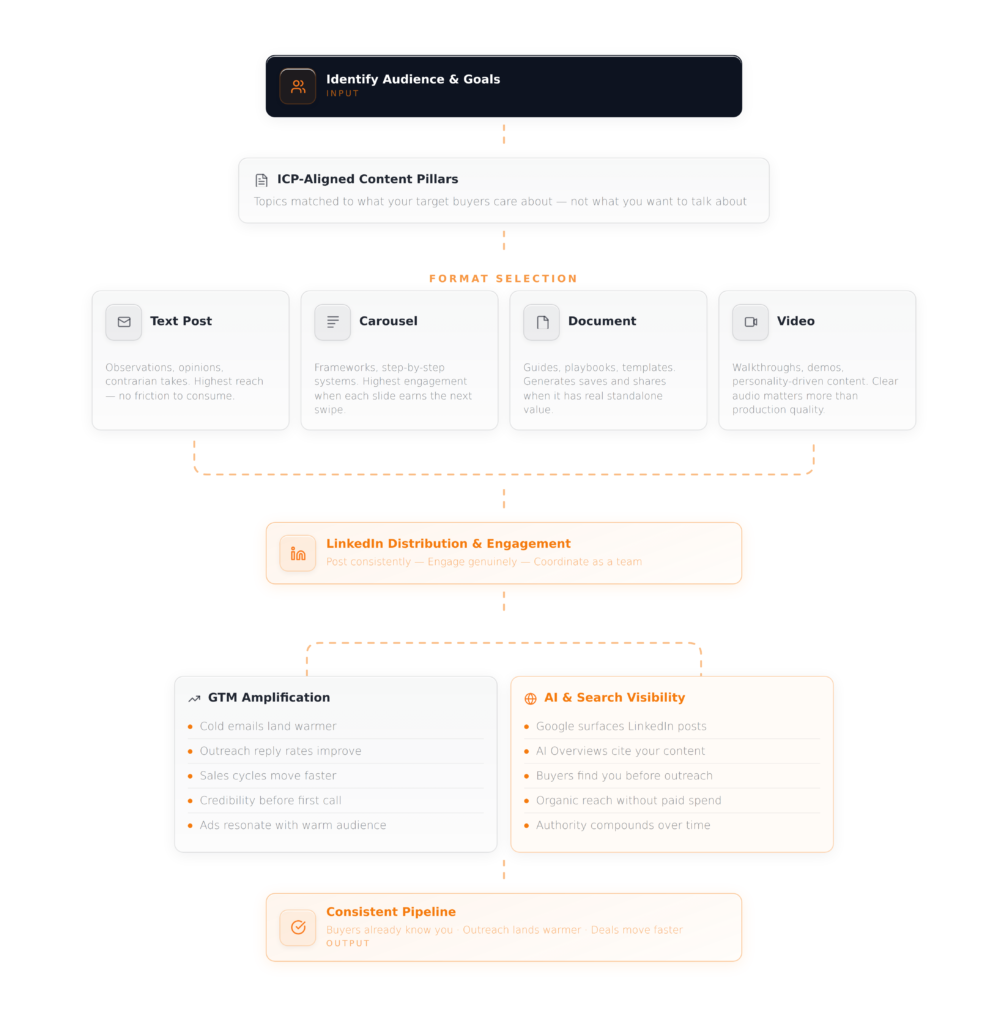
Formats and When to Use Them
The format choice matters. The wrong format for a given topic either undersells the idea or creates friction that stops people from engaging.
Text only
Best for: observations, opinions, short insights, contrarian takes, honest admissions.
Text posts have the highest reach on LinkedIn because they don’t require any action to consume. You read it in the feed. No clicking, no downloading. The entire value is delivered in the scroll.
Use text when your idea can be fully communicated in under 300 words and doesn’t require visual explanation. If you’re adding an image just to add an image, leave it out.
Carousels (document posts)
Best for: frameworks, step-by-step processes, comparisons, educational content that benefits from a structured flow.
Carousels are the highest-engagement format on LinkedIn when done well. They work because they create a reason to swipe — each slide should make the reader want to see the next one.
Design principles that matter: one idea per slide, large readable text, minimal copy per slide, a strong first slide that acts as a hook, a final slide with a clear takeaway or soft CTA.
Don’t use carousels for content that would work fine as a text post. The production effort isn’t worth it for a simple observation.
Native documents (PDFs)
Best for: frameworks, guides, templates — content with enough depth to warrant a download. Document posts display as a preview in the feed and require a click. They generate saves and shares when the content has genuine standalone value outside LinkedIn.
Images
Best for: data visualisations, diagrams, before/after comparisons. A standalone image with no supporting context rarely works. The image needs to communicate something specific — a diagram that makes a complex idea immediately clear, a data point that stops the scroll. Custom-designed images consistent with your brand perform significantly better than stock photos.
Video
Best for: walkthroughs, demonstrations, anything that benefits from tone and personality. Native video has strong reach on LinkedIn. Short-form under 90 seconds works best for feed consumption. Clear audio matters more than production quality.
How to choose:
Start with the idea, not the format. What’s the simplest format that fully communicates this? Default to text. Upgrade to carousel or document when structure genuinely adds value. If you’re adding a format for its own sake, leave it out.
The Team LinkedIn Strategy
One person posting consistently is good. A coordinated team posting on related topics from different angles is a different order of magnitude.
When leadership, managers, and individual contributors across departments are all posting about the same themes — targeting, pipeline, GTM systems, their specific domain — the company becomes genuinely present in its buyers’ feeds. Not as a brand, but as a collection of real people with real perspectives on problems the buyer is dealing with.
The key word is coordinated, not scripted. You’re not asking everyone to post the same message. You’re aligning on themes and letting each person bring their own angle based on their role and experience.
How to structure it:
Define two or three content themes per quarter that align with your GTM focus. These become the shared territory. Everyone posts within these themes — but from their own perspective.
The CEO or founder posts at the strategic level: observations about the market, positioning takes, the thinking behind company decisions.
Sales leaders post from the field: what they’re hearing in conversations, patterns in deals, what objections are coming up and how to address them.
Marketing leaders post about demand and content: what’s working, what buyers are responding to, how to connect content to pipeline.
Practitioners post at the execution level: specific tactics, frameworks they’re using, tools they’ve tested, lessons from real work.
The result is that a prospect encounters multiple people from the same company speaking credibly about problems they care about. Each post reinforces the others. The company’s authority compounds without any single person having to carry the full weight.
Practical coordination:
A shared Notion or Slack channel where team members post ideas, share drafts for feedback, and flag topics being covered that week. Not a rigid approval process — a lightweight way to avoid duplication and stay coordinated.
A monthly 30-minute sync to review what’s working, adjust themes based on what’s resonating, and align on the next month’s focus.
Ghost-writing support for leaders who have strong perspectives but not the time or inclination to write regularly. The ideas and voice should be genuinely theirs — the writing support just removes the friction.
What Consistent Actually Looks Like
The biggest failure mode is unsustainable effort. Teams launch a LinkedIn strategy with daily posting and detailed analytics reviews — and burn out within six weeks.
Consistency over intensity. Three posts per week for a year compounds into something real. Ten posts a week for a month then silence does not.
Three to four posts per week is sustainable if the process is right. Capture ideas as they happen — a note in your phone, a voice memo, a running doc — so you’re never starting from nothing. Block two hours every two weeks to write five to eight posts in one sitting. Keep them in draft, adjust based on what’s happening in the market, then schedule.
Repurposing extends the value of every piece of thinking. A strong article becomes three posts. A framework from a client project becomes a carousel. A lesson from a sales call becomes a text post.
Engagement matters as much as posting. Commenting on posts from people in your target accounts, responding to comments on your own posts — this is where relationships form and where the algorithm rewards you with reach.
The goal is not to become a LinkedIn influencer. The goal is to be consistently visible and credible to the specific people you’re trying to reach — so that when your outreach arrives, or when they’re ready to buy, your name is already familiar.
At Qualeady, we build LinkedIn thought leadership strategies that connect directly to your GTM motion — ICP-aligned content, team coordination, and a system that compounds over time rather than burning out in six weeks. Get in touch if you want to build yours.