
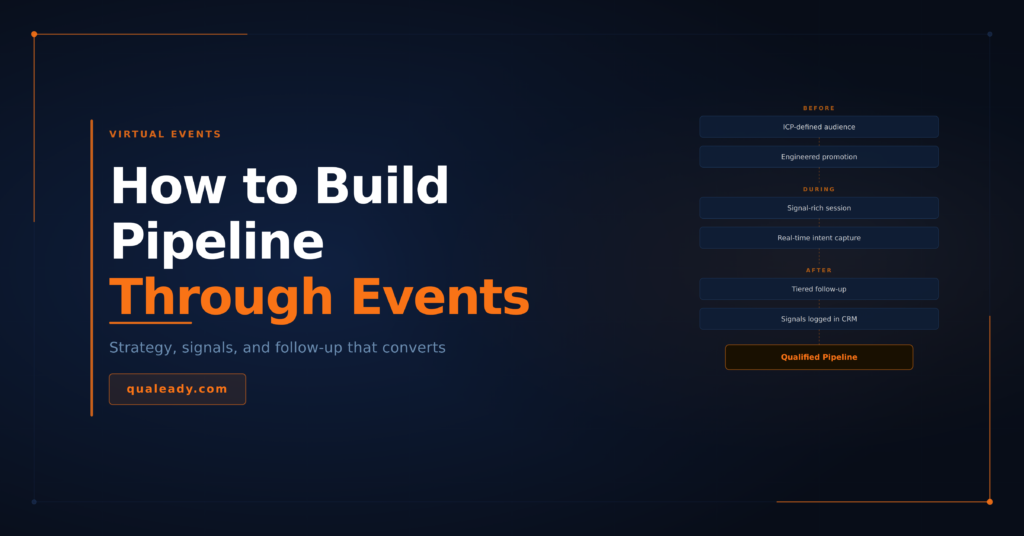
Virtual events B2B pipeline generation is one of the most efficient demand channels available, when it’s built as a system, not a one-off moment.
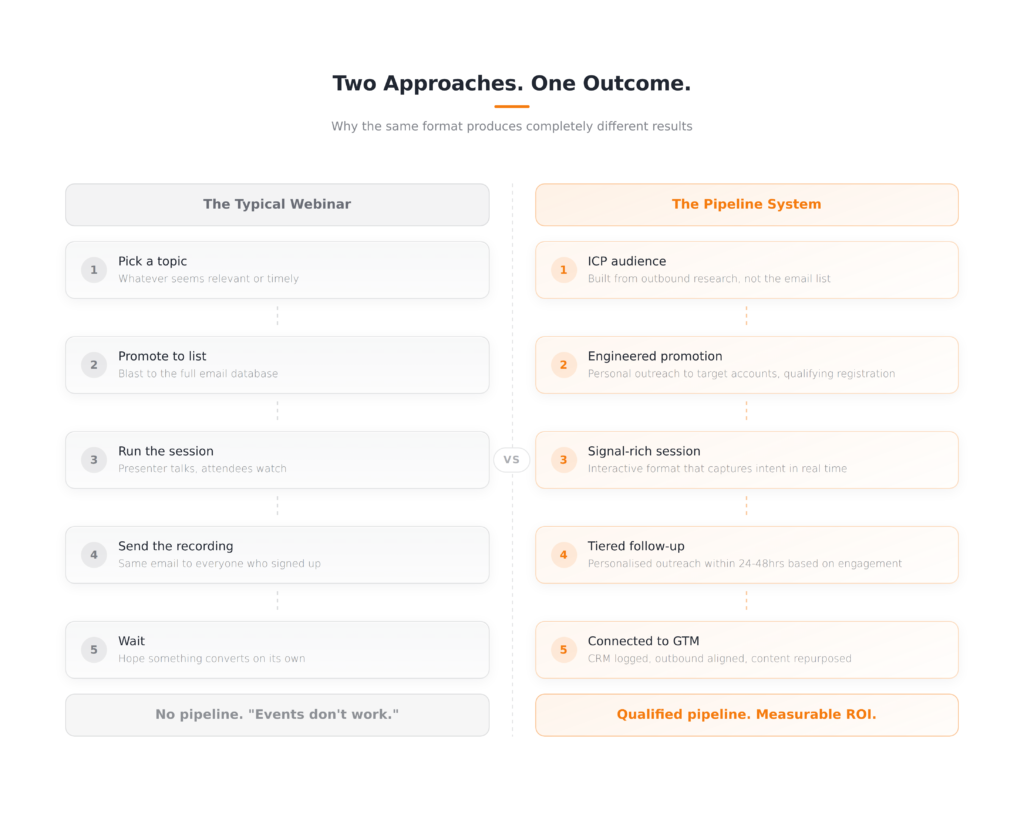
Let’s say a company decides to run a webinar. They pick a topic that sounds interesting, promote it to their email list, get a few hundred sign-ups, run the session, send out the recording, and wait. When nothing converts, the conclusion is that virtual events don’t work for them
The event didn’t fail. The system around it was never built.
Here’s what the data actually shows. Virtual events convert from lead creation to qualified opportunity at 6.41%, the highest efficiency rate of any marketing channel studied across 198 B2B SaaS companies and 2.6 million deals. (HockeyStack, 2025)
Source: HockeyStack — The State of Event Marketing in 2025
That number doesn’t come from running better webinars. It comes from treating the event as one moment inside a larger system, where the audience is engineered, signals are captured in real time, and the follow-up motion fires before intent decays.
The Case for Virtual Events as a B2B Pipeline Channel
Event-sourced leads convert to opportunities at 40%. The average across other marketing channels is 4.82%. (HockeyStack, 2025)
Source: HockeyStack — The State of Event Marketing in 2025
72% of marketers say prospects close deals faster after attending an event. 31% report a 20 to 30-day decrease in sales cycle length for event-sourced deals.
Source: HockeyStack — The State of Event Marketing in 2025
And on cost: a qualified lead from a trade show costs $811 on average. A qualified lead from a virtual event costs $127.
Source: The Starr Conspiracy — B2B Marketing ROI Benchmarks
The reason the numbers look like this is intent. Someone who shows up to a focused virtual event on a specific business challenge is not the same as someone who clicked an ad or filled out a form to download something. They came because the topic was relevant to them right now. That intent is what drives the conversion rates.
52% of marketers attribute at least half of their company’s closed-won deals to events. (HockeyStack, 2025)
Source: HockeyStack — The State of Event Marketing in 2025
But 45.7% of marketers say the primary goal of virtual events is to generate pipeline, while many are still running them the same way they’d run an internal training session.
Source: Markletic — Virtual Event Statistics
Saying pipeline is the goal and engineering it as the outcome are two very different things.
Start With the Audience, Not the Topic
The single biggest reason virtual events don’t generate pipeline is the wrong people in the room.
I’ve seen this consistently. A company runs a webinar, gets 400 registrants, has a great session, and books two meetings. When we dig into who actually registered, half the list is students, competitors, people at companies that would never buy, or junior staff with no decision-making authority. The event was fine. The audience was wrong.
A large registration number is not a success metric. Density of qualified buyers is.
This means starting with your ICP, not your email list. Before you write the topic, define exactly who you want in the room: industry, company size, role, seniority, and ideally a specific trigger or context. Someone at a 20-person startup and someone at a 500-person enterprise are in completely different situations even if they have the same job title. Be precise about who you’re building this for.
Then build your invite list from that definition. Your email list is convenient but it’s not curated. A list built from your ICP using outbound research, Sales Navigator, and your existing network is a fundamentally different starting point.
On promotion: 39% of B2B companies say their sales teams are responsible for generating a significant share of registrations.
Source: Markletic — Virtual Event Statistics
This matters because a personal outreach from a rep to a target account converts at a completely different rate than a broadcast email. Someone who registered because a human reached out to them personally shows up differently than someone who clicked a promotional post.
Give the registration page a job too. A frictionless sign-up that anyone can complete attracts anyone. A single qualifying question, like what’s your current challenge, what’s your team size, or what are you focused on this quarter, filters the list and gives your follow-up team real context before the event even happens.
Be specific about who the event is for. “This session is designed for revenue leaders at B2B SaaS companies scaling past $5M ARR” tells the right people they’re in the right place and gives everyone else a clear reason not to sign up. Specificity in positioning produces a more qualified audience than broad appeal every time.
On timing: the average promotional period for a virtual event is 3.5 weeks. For C-level audiences, it runs closer to six.
Source: Markletic — Virtual Event Statistics
Compressing that window to save time sacrifices both registration volume and show-up rates. Build the timeline backwards from the event date and start promoting earlier than feels necessary.
Design the Event for Signals, Not Just Attendance
Stop thinking about your virtual event as content delivery. Start thinking about it as signal generation.
A presenter talks, attendees watch, a poll pops up once. That format produces an audience that was present but invisible to your sales team. You know they were there. You know almost nothing about what they’re thinking, what’s urgent for them, or where they are in a buying process.
An event designed for pipeline generation is designed so that every interaction tells you something useful.
Format matters more than production value. A panel discussion among genuine peers, a focused workshop with real takeaways, or an exclusive roundtable with a senior guest creates a different quality of participation than a polished product presentation. For pipeline generation, intimacy and specificity beat scale. A 40-person event where everyone is qualified and engaged will outperform a 400-person webinar where most attendees are passive every time.
Interactive elements are not optional. Live polls, open Q&A, chat discussion, breakout conversations. These do two things at once. They keep attention. And they generate the data your follow-up team needs. Who asked a question tells you who’s engaged enough to raise their hand. What they asked tells you where they are in their thinking. Who stayed for the full session versus dropped off after 20 minutes is a buying signal. Who interacted with other attendees is a signal of a different kind.
These are intent indicators. Treat them that way.
Don’t pitch. This sounds obvious and gets ignored constantly. The fastest way to kill engagement and lose the trust of an audience you’ve carefully curated is to spend the session selling. Deliver genuine value. The commercial conversation belongs in the follow-up, not on the stage. People who leave your event thinking “that was actually useful” convert. People who leave thinking “that was a sales pitch” don’t, and they tell people.
On show-up rates: webinar attendance averages 44% of registrants for live sessions, with another 23% engaging with the on-demand recording within 30 days.
Source: The Starr Conspiracy — B2B Marketing ROI Benchmarks
Plan your follow-up motion separately for both groups. A live attendee and a no-show have completely different contexts. They should not receive the same email.
Capture the Right Signals in Real Time
What you capture during the event determines what your sales team can do with the 48 hours that follow.
Every event platform gives you basic attendance data. That’s not enough to run a meaningful follow-up. The signals that actually matter are behavioural: what each person did during the session, not just whether they showed up.
Before the event ends, you want to know:
- Who attended versus who registered but didn’t show
- How long each person stayed: 20 minutes or the full hour
- What questions they submitted in the Q&A, and what those questions reveal about their situation
- How they responded to polls, which often surface buying intent directly
- Whether they engaged in chat or sat passively
- Whether anyone requested follow-up materials or raised their hand for a conversation
These data points need to be in your CRM before anyone sends a single follow-up email. An attendee who submitted two questions, stayed for the full session, and responded to a poll about a specific pain point is a completely different conversation from someone who joined late, stayed for 15 minutes, and said nothing.
Tier your attendees by engagement depth before your sales team touches them:
High engagement goes into a priority track with personal outreach within 24 hours.
Medium engagement goes into a personalised nurture sequence with the recording and a relevant point from the session.
Registered but didn’t attend gets a dedicated re-engagement sequence. They raised their hand by signing up. That intent doesn’t disappear because they missed the session.
The goal is to make every follow-up action informed by something real, not sending the same message to everyone on the list regardless of what they did during the session.
The 72-Hour Window Is Where Pipeline Is Won or Lost
Intent is highest in the hours immediately after the event. That’s not an opinion. It’s what the conversion data consistently shows.
The 24 to 48-hour window after an event is when follow-up rates peak and when manual processes consistently fail to keep up.
Source: Outport AI — Virtual Event Marketing Strategy
Speed matters. Relevance matters more.
A “thank you for attending” email with a link to the recording is a courtesy. It’s not a follow-up. It doesn’t move a conversation forward.
A follow-up that references something specific, like a question someone asked, a comment they made, or a poll response that revealed something about their situation, tells them you were paying attention. That changes how the message lands. It goes from feeling like part of an automated sequence to feeling like the start of an actual conversation.
Here’s how to structure it by engagement tier:
High engagement attendees get a personal call or email from a sales rep within 24 hours. Reference something specific from the session. Ask a direct question about their situation. Don’t send the recording. They were there.
Medium engagement attendees get a personalised email within 48 hours with the recording and one relevant takeaway from the session that connects to their profile. Soft CTA to continue the conversation.
No-shows get a different sequence. Lead with what they missed and why it’s relevant to them specifically. Give them the recording with context. Follow up once more if they open and engage.
Anyone who asked about pricing, mentioned a specific problem, or directly requested a follow-up during the session should not be going into a nurture flow. They should be on a rep’s call list within the hour.
Virtual Events Don’t Work in Isolation
A virtual event that sits on its own in your GTM calendar is a one-off moment. A virtual event that’s connected to your outbound motion, your LinkedIn presence, and your CRM is a pipeline channel.
Outbound and events amplify each other. If you’re running outreach sequences to a specific segment, a virtual event on a topic directly relevant to that segment gives every rep a natural reason to reach out. “We’re running a session for [specific role] at [specific company type] on [specific topic] next week. Thought it might be relevant given what you’re working on” is a better conversation starter than a cold pitch. It gives the prospect a reason to engage that isn’t a sales call.
Registrants who came through outbound show up differently too. They already have some context on who you are. That matters in a session where engagement is the point.
LinkedIn extends the reach. Posting about the event in the weeks leading up to it, the topic, the angle, why this conversation matters now, reaches the right audience organically if your content is ICP-aligned. We’ve seen this consistently: attendees who encountered the topic on LinkedIn before they registered show up more engaged than attendees who came in cold through email.
The event becomes weeks of content. The recording is a distribution asset. Clips are LinkedIn posts. Key insights become a follow-up article. A framework from the session becomes a resource. One well-executed event, properly repurposed, keeps the conversation going with the right audience for weeks after the session ends.
CRM connectivity closes the loop. Every signal, registration, attendance, duration, questions, post-event clicks, needs to be in the CRM before sales acts. Without that, the event is disconnected from your pipeline motion and attribution is guesswork. With it, you can measure cost per qualified conversation, track which attendees became opportunities, and use that data to make the next event better.
74% of B2B event organizers only see a positive ROI at least six months after the event.
Source: Markletic — Virtual Event Statistics
The teams that see it sooner are the ones with the follow-up motion, the CRM integration, and the connected GTM approach already in place. Not the ones who ran a better webinar.
What the Full System Looks Like
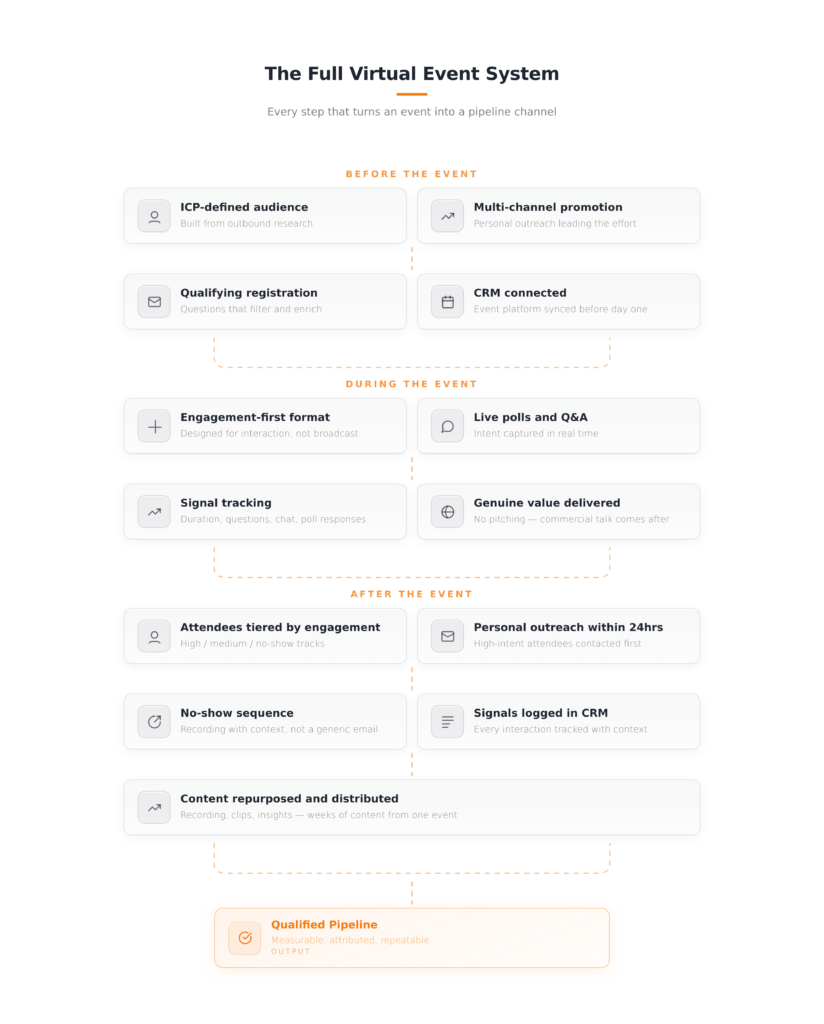
Before the event: ICP-defined audience built from outreach research, not just your email list. Multi-channel promotion with personal outreach leading the effort. Registration page with a qualifying question. Six-week promotional window for senior audiences. Event platform connected to your CRM.
During the event: Format designed for engagement, not passive consumption. Interactive elements that generate signals. Content that delivers genuine value without pitching. Someone actively capturing questions and discussion threads throughout the session.
After the event: Attendees tiered by engagement before any follow-up fires. High-intent attendees contacted personally within 24 hours. Recording sequence for no-shows. All signals logged in CRM with context. Recording and insights repurposed into ongoing content.
Remove any piece of this and the system underperforms. This is not a webinar strategy. It’s a pipeline system that happens to include a live event in the middle of it.
At Qualeady, we build and run virtual events as part of a connected GTM motion — from audience targeting and registration setup to live execution and post-event follow-up. If you want to turn your next event into a real pipeline channel, get in touch.