
There’s more outreach happening today than at any point in the history of B2B sales.
And fewer replies than ever.
That’s not a coincidence. The tools got better. The thinking got lazier. And somewhere between the automation workflows and the AI-generated first lines, the actual human on the other end got forgotten.
This guide is about getting back to what works — and understanding why it works. We’ll cover the classic frameworks that built the foundation of modern selling, what the pre-AI era got right and wrong, what AI actually changed about sequences (the good and the not so good), and what a well-built outreach sequence looks like today when it’s driven by intelligence rather than volume alone.
By the end you’ll have a clear picture of what belongs in a 2026 sequence, what to leave out, and how to build something that earns replies instead of just filling up outboxes.
What a Sequence Actually Is
A cold outreach sequence is a structured series of touchpoints designed to start a conversation with someone who doesn’t know you yet. Everything else — the channels, the timing, the tools, the personalization — is in service of that one goal. When teams lose sight of it, sequences stop working regardless of how sophisticated the setup looks.
Worth saying clearly: a sequence is not a pipeline by itself. It’s the bridge between a targeted list and a real conversation. What happens in that conversation is a different subject — but a good sequence gets you there.
The Frameworks That Still Matter
Before there were sequences, there were conversations. And before cold email, there was cold calling. The frameworks built for those conversations are still the most useful thinking tools in outreach today — not because the world hasn’t changed, but because human psychology largely hasn’t.
AIDA — Attention, Interest, Desire, Action
AIDA dates back to the late 1800s. It maps the psychological journey a buyer moves through before taking action — Attention, Interest, Desire, Action. Every cold email ever written follows some version of this structure whether the sender intended it or not. The subject line handles Attention. The opener handles Interest. The value proposition handles Desire. The call to action handles Action.
The mistake is applying AIDA mechanically — cramming all four stages into a single email that reads like a scripted pitch. It works better when you think of it across a sequence. The first touch earns attention and sparks interest. The follow-up deepens desire. The later touch makes the ask.
PAS — Problem, Agitate, Solution
PAS is simpler. Identify the problem, make the reader feel its weight, present the solution. It works in cold outreach because it starts with the reader’s world rather than yours. You’re not opening with “we help companies do X.” You’re opening with a problem they likely recognize.
The thing to watch with PAS is the agitation step. Done well, it creates real resonance — the reader thinks “yes, that’s exactly what’s happening.” Done poorly it comes across as presumptuous, like you’re telling someone their house is on fire so you can sell them insurance. The line between the two is specificity. Generic agitation lands flat. Specific, contextual observations land differently.
SPIN Selling — Situation, Problem, Implication, Need-Payoff
Neil Rackham built SPIN from studying thousands of real sales conversations. The framework shifted focus from pitching to questioning — helping buyers articulate their own pain and the consequences of leaving it unsolved.
SPIN wasn’t designed for cold email but its logic is deeply relevant. The best cold outreach doesn’t tell prospects what they need. It reflects something back to them that they already know and connects it to a conversation worth having. The Implication step is where most outreach falls short — emails pitch the solution before the prospect has connected their problem to any real consequences. SPIN’s core insight is that the buyer needs to feel the weight of the problem before the solution becomes interesting.
A Note on MEDDIC
MEDDIC — Metrics, Economic Buyer, Decision Criteria, Decision Process, Identify Pain, Champion — is worth understanding even at the outreach stage, not as a checklist but as a thinking tool that quietly shapes your approach.
The Pain and Champion elements are the most relevant here. When you’re choosing which contact to reach out to first, you’re already making a Champion decision — is this person someone who owns the problem and has influence, even if they’re not the final decision maker? When you end a first touch with a question like “Is this something your team is actively working through right now or still further down the roadmap?” — that’s the Pain element surfacing naturally in a CTA without feeling like an interrogation.
MEDDIC doesn’t belong in your email copy. It belongs in the thinking that shapes your contact selection, your questions, and how you guide the conversation once someone replies. A good sequence earns the discovery call. MEDDIC helps you make the most of it once you’re there.
What All of These Have in Common
Every framework listed here starts with the buyer. Their psychology, their situation, their pain, their decision process. Not your product, not your features, not your company story.
That principle hasn’t changed. The channels and tools have. The psychology hasn’t.
The Pre-AI Era — Volume, Templates, and What Actually Worked
Around 2015 to 2020, cold email scaled fast. Tools like Outreach, SalesLoft, Mailshake, and Woodpecker made it straightforward to build multi-step sequences and send at volume. Apollo gave teams access to large databases.
LinkedIn became a parallel outreach channel. The logic driving most of this was simple — if a small percentage of emails convert, send more emails.
Sequences got longer. Templates got shared across teams and companies. The same email that worked in one context got copy-pasted into a hundred others with the company name swapped out. Follow-ups became automated bumps with no real content behind them.
Inboxes got noisier. Buyers got better at filtering outreach. Reply rates dropped across the board — not because outreach stopped working, but because the quality of what was being sent declined as volume went up.
The fundamental mistake of that era wasn’t sending volume. Volume is still a real lever — higher quality outreach at meaningful scale still produces results. The mistake was treating outreach as a numbers game and letting volume substitute for thinking. When templates replace genuine relevance and follow-ups replace real reasons to respond, volume amplifies the problem rather than solving it.
That said, the pre-AI era established something that remains true today: multi-touch sequences work. One email is rarely enough. Buyers are busy, timing matters, and a structured sequence gives you multiple legitimate opportunities to land at the right moment. The multi-touch principle wasn’t wrong. The execution around it often was.
The sequences from that era had a recognizable shape that you’ll still see running today — an intro pitch, a “just following up” bump, a slightly reworded version of the same pitch, and a breakup email asking if the prospect wants to be left alone. Each touchpoint was designed to extract a response rather than to say something genuinely worth responding to. That’s the pattern worth breaking.
What AI Changed — and Where Teams Went Wrong
AI changed cold outreach in two meaningful ways.
The first is research speed. Summarizing a prospect’s LinkedIn activity, surfacing recent company news, identifying funding rounds, tracking job postings that signal a strategic shift — work that used to take 20 minutes per prospect can now run automatically across hundreds of accounts. Clay is a very powerful tool in this space — it lets you enrich lead lists with signals from multiple data sources, build conditional research workflows, and surface context that makes outreach more relevant without requiring hours of manual work. When AI accelerates research and surfaces better inputs for human thinking, it genuinely improves the quality of outreach.
The second change is where things got complicated. AI made it easy to generate personalized-sounding email copy at scale. Teams started using it to write first lines based on prospect research, and a lot of that output looked something like this:
“Hi [Name], I came across your recent post about scaling your sales team and was genuinely impressed by your perspective on pipeline efficiency. Your approach to building systems resonates deeply with what we’re seeing across high-growth companies…”
Three sentences of generated flattery before a pitch the reader could see coming from the first word. People buy from people they trust — and the moment a message feels constructed to impress rather than written to communicate, that trust doesn’t form. Readers don’t always identify it as AI. They just feel something is off.
The more honest take on AI in cold outreach is this: it’s a useful tool when used with intention. AI can help you brainstorm angles, structure a sequence, draft ideas when you’re stuck, or generate variations to test. But the output needs a human filter — someone who knows the ICP, understands the offer, and can tell the difference between a message that sounds relevant and one that actually is. AI trained on your business context, your client stories, and your positioning will produce better starting points than a general-purpose prompt. It’s still a starting point, not a finished email.
The teams who use AI well treat it as a thinking partner, not a ghostwriter. The ones who use it badly let it write the outreach and wonder why it feels hollow.
We’ll cover how to actually build and train AI for your GTM workflow in a separate article — there’s enough to that topic to give it proper treatment.
The Real Problems With Modern Sequences
Before getting into what works, it helps to name what’s actually breaking things.
The first is complexity without intention. Sequences with 10 touchpoints across four channels and conditional logic based on email opens look impressive inside a platform like Smartlead or Instantly. But complexity alone doesn’t produce results — thinking does. A four-touch sequence where every message earns its place will outperform a twelve-touch automation built on templates. And a seven-touch sequence built with real account segmentation, genuine triggers, and a different angle at each step will outperform both. The number of touches isn’t the problem. Touches without a reason are.
The second is measuring the wrong things. Open rates and emails sent are activity metrics. Replies and qualified conversations are outcome metrics. A campaign that sends 500 targeted emails and generates 8 real conversations outperforms one that sends 3,000 and generates 5. Optimising for volume without tracking outcomes is how teams stay busy without building pipeline.
The third is surface-level personalization. Changing the first line but leaving the pitch identical across every segment misses the point. A VP of Product and a Head of Revenue at the same company have different problems, different language, and different reasons to care. Sending them the same pitch with different openers is cosmetic variation, not real relevance.
The fourth is following up without a reason. “Just checking in” tells the prospect nothing except that you noticed they didn’t reply — which they already know. A follow-up earns its place by adding something: a different angle, a relevant observation, a piece of content that directly connects to what you said in the previous touch.
The Qualeady ACTS Framework
ACTS stands for Account, Contact, Trigger, Story. It’s the system we use to build outreach that gets replies — and it requires real thinking at every layer. That thinking is exactly what separates outreach that gets ignored from outreach that starts conversations.
A — Account
Before you write anything, segment at the account level. Not just by industry and company size — by what’s actually happening at the account.
Start with what they sell and who they sell it to. A SaaS company selling to mid-market financial services has a different operational reality than a SaaS company selling to e-commerce brands. Same firmographic profile on paper. Completely different context in practice.
Then look at their growth stage. A company that recently raised a round and is scaling fast has different problems and urgency than one that’s been operating steadily for years.
Then look at signals. Recent job postings, technology in their stack, press coverage, product announcements — these tell you whether this account is likely in motion on the problem you solve.
And look at their clients. This one gets missed regularly. If you’re selling a service and you have strong clients in logistics, dropping those names in an email to a fintech company doesn’t land — it creates distance rather than credibility. Match your proof points to the prospect’s world. Reference clients from their industry or clients solving similar problems in adjacent spaces. If you don’t have a direct match yet, reference the type of problem rather than the client name.
C — Contact
Within each account, you’ll often have multiple relevant contacts. A VP of Sales and a Head of Marketing can both be relevant buyers for the same solution — but they are not the same conversation.
Segment by role and department. What does this person own? What are they measured on? What’s the version of the problem that lands in their world specifically?
Segment by seniority. A C-suite conversation is about business outcomes and strategic risk. A director-level conversation is about operational execution and team performance. A manager-level conversation is about day-to-day friction and tools. Same solution. Three genuinely different entry points.
Look at their public activity. What have they written, shared, or spoken about? Not to find something to reference for the sake of it — but to understand how they think and where their head is at professionally.
T — Trigger
The trigger is the specific reason you’re reaching out to this person at this moment. It answers the “why now” question — and without a real answer to that, even a well-written email feels arbitrary to the reader.
Context comes from signals. Some sit at the account level, some at the contact level.
Account-level signals include things like a recent funding round, a new product launch, expansion into a new market, an executive hire, press coverage, or job postings that reveal a gap the company is actively trying to fill.
Contact-level signals are about the individual — a conference talk or webinar they gave, an article or LinkedIn post they published, a perspective they shared publicly, or a recent role change.
The key is using the signal to say something genuinely relevant — not just to justify the outreach. To make that distinction concrete, here’s how the same trigger plays out when it’s handled lazily versus when it actually earns a reply.
The lazy version:
“Hi [Name], I saw you speak at [Event] — great insights on growth. I wanted to reach out because we help companies like yours with…”
The webinar mention does nothing here. It’s a warm-up sentence with no real content. The prospect reads “I used your talk as a reason to pitch you” and moves on.
A better version:
“Caught your session at [Event] — the part about moving upmarket while keeping your outbound motion intact stood out. That tension between growth stage and sales system is something we deal with a lot working with [industry] teams. Curious whether that’s still a live challenge for you or whether you’ve found your way through it.”
The difference is that the second version actually engages with what they said. It demonstrates real attention, not performed attention. It connects to a genuine problem. And it ends with a question that invites a reply without making a demand. There’s no pitch yet — just the start of a real exchange.
If you can’t find a trigger that lets you say something genuinely relevant, don’t force one. A clean, well-segmented email without a manufactured hook outperforms an email built around a weak or hollow reference.
S — Story
This is where everything comes together. With the account researched, the right contact identified, and a real trigger in hand — now you write. The message is the story you tell about why you’re reaching out, why now, and why this specific person should care. Get those three things right and the email almost writes itself.
A few principles that apply to every message in the sequence.
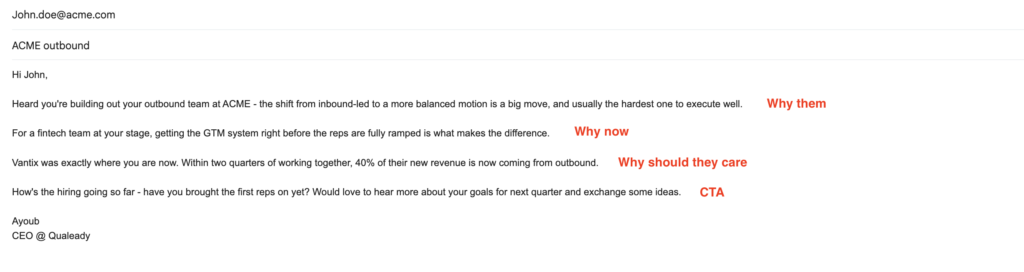
Answer why them, why now, why should they care. These three questions should be answerable from every message you send — not just the first one. Why this specific person? Why is now the relevant moment? What’s actually in it for them to reply?
Lead with their world, not yours. The first sentence should live in their reality — their situation, their challenge, their context. Not your company, your solution, or what you’ve helped others achieve. Earn the right to pitch before you pitch.
Be direct about what you want. Once you’ve established relevance, be clear about what you’re asking for. Vague “would love to connect” language makes prospects work harder than they should to understand what you want from them. One clear ask. One.
Keep it short. If it takes more than 90 seconds to read, it’s asking too much. Brevity signals that you respect their time, which is itself a form of credibility.
The ACTS framework shapes your thinking before you write. Before hitting send, run every message through three questions — why them, why now, why should they care.
Here’s what ACTS looks like in practice.
Let’s say Qualeady is reaching out to a VP of Sales at ACME, a 120-person fintech company. The VP recently posted on LinkedIn about transitioning the team from inbound-led to a more balanced motion. The company also posted two open SDR roles in the last 30 days — a clear signal the team is actively building outbound capacity but the GTM system behind it likely isn’t in place yet.
Account segmented. Right contact identified. Trigger confirmed. Now the Story:
The LinkedIn Layer — Social Selling as a System
LinkedIn isn’t just a touchpoint in a sequence. Used consistently, it changes the entire dynamic of cold outreach.
When a prospect receives a cold email from someone they’ve seen commenting thoughtfully in their industry conversations — or whose posts they’ve actually read — the email lands differently. It’s not a cold contact from a stranger. It’s a recognizable name from their professional world.
This takes time to build but it compounds. Commenting genuinely on posts from people in your target accounts, publishing consistent thought leadership that addresses real problems your ICP cares about, engaging with conversations in your space — none of this produces immediate pipeline. All of it makes your outreach warmer over time.
When referencing a prospect’s LinkedIn activity in outreach, the same standard applies as any other trigger. Only use it if you can say something genuinely relevant about what they shared. A comment they made about a strategic challenge is a real entry point. A post they liked is not.
What a Modern Sequence Looks Like in 2026
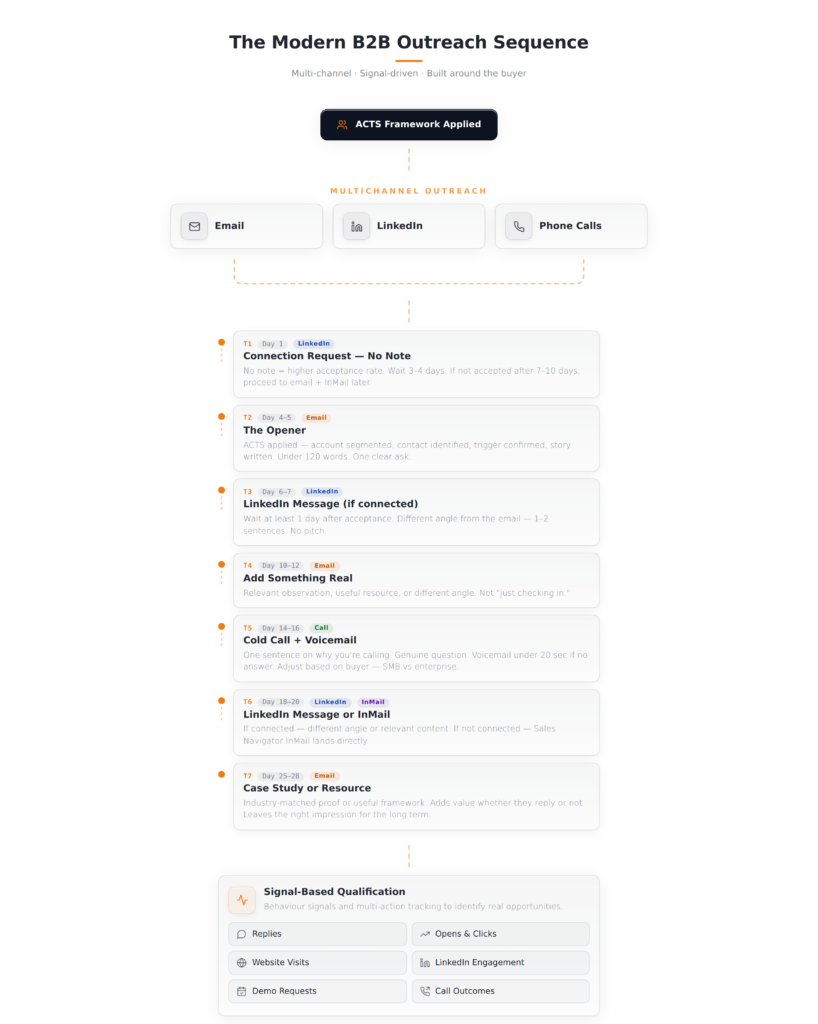
There’s no one-size-fits-all sequence. But there is a structure that works — and a clear logic behind each touchpoint. Here’s what a well-built outreach sequence looks like today.
The Main Sequence
Touch 1 — LinkedIn Connection Request, No Note (Day 1)
Start on LinkedIn before going anywhere near their inbox. Send a connection request without a note — acceptance rates are higher without one. A note signals a pitch is coming and many prospects decline to avoid it.
If they accept within the first few days, wait at least one day before sending a message. Don’t jump into their inbox the moment they connect — that’s the quickest way to feel like a sequence.
If they haven’t accepted after 7–10 days, don’t wait. Move to email and use LinkedIn InMail via Sales Navigator as a parallel channel later in the sequence.
Touch 2 — Email: The Opener (Day 4–5)
Go to the inbox with your ACTS work done. Account segmented, right contact identified, trigger confirmed, story written. One clear ask — a relevant question or a short call. Under 120 words.
Touch 3 — LinkedIn Message (Day 6–7, if connected)
Wait at least one day after they accept before messaging. Keep it short — a different angle from the email, not a copy of it. One or two sentences.
Example: “Hey [Name], noticed you’ve been building out the [team] at [Company] — curious how you’re managing [specific challenge relevant to their role] today.”
No pitch. Ends with a genuine question. If you don’t have a specific reference that earns its place, skip it and lead with the question.
Touch 4 — Email: Add Something Real (Day 10–12)
A follow-up that earns its place. A relevant observation, a useful resource, a different framing of the problem you raised in touch two. Not “just checking in” — that tells the prospect nothing except that you noticed they didn’t reply, which they already know.
Touch 5 — Cold Call (Day 14–16)
A short, direct call. One sentence on why you’re calling and a genuine question. If no answer, leave a voicemail under 20 seconds — same angle as your emails, different format.
How much you lean on calling depends on your buyer. For SMBs, direct numbers are often on the website and decision makers are more reachable. For enterprise, getting through without a direct number is harder and unsolicited calls can create more friction than opportunity. Read your market and adjust.
Touch 6 — LinkedIn Message or InMail (Day 18–20)
If connected, a second short message with a different angle or a relevant piece of content. If they never accepted the connection request, this is where Sales Navigator InMail comes in — a direct message that lands in their LinkedIn inbox without needing a connection.
Touch 7 — Email: Relevant Case Study or Resource (Day 25–28)
Something useful that closes the sequence on a strong note. A client result from their industry. A framework connected to their challenge. It adds value whether they reply or not — and leaves the right impression. A prospect who doesn’t reply today might refer someone tomorrow or come back when timing changes.
High Intent Follow-Up — Priority Track
Some prospects will show signals mid-sequence without replying. Multiple email opens, link clicks, or a website visit tracked via a tool like RB2B — these are worth a different level of attention.
When a prospect hits these triggers, pause the standard sequence. Don’t just move faster — move smarter.
Before reaching out, the SDR should take 15–20 minutes to go deeper on that prospect. Review the full account, revisit their LinkedIn profile, look for new triggers or angles that weren’t there before, and refine the messaging specifically for them. A high intent signal means they’re paying attention — the next touch needs to earn that attention, not waste it with a generic follow-up.
Step 1 — Call first. Strike while the signal is fresh. Short and direct — reference your previous email in one sentence and ask if it’s a good time. Don’t mention that you saw them on your website. Let the relevance do the work.
Step 2 — Targeted email same day or next morning if you didn’t connect on the call. Come from a new angle based on what you found in your deeper research. One clear ask. Nothing recycled from the standard sequence.
Intent decays fast. Someone actively looking at your solution today may have moved on or made a decision by next week. Speed matters here — but so does the quality of what you send.
The Thought Leadership Cadence Running in the Background
While the outreach sequence is running, there’s a parallel track that makes everything else work better — your LinkedIn presence.
Posting relevant content consistently, commenting genuinely on posts from people in your target accounts, and engaging in conversations your prospects are already having. None of this produces immediate pipeline. All of it builds the kind of trust and familiarity that makes cold outreach warmer over time.
When a prospect receives your email and recognizes your name from a post they read or a comment you left on a conversation they were in — the email lands differently. You’re not a stranger anymore. You’re someone they’ve seen thinking about the same problems they think about.
The content should be genuinely useful to the exact people you’re trying to reach. If your ICP is VP of Sales at mid-market SaaS companies, your content should speak directly to the challenges that audience faces. That’s what earns the attention. That’s what makes the connection request feel natural instead of transactional.
The thought leadership cadence doesn’t replace outreach. It amplifies it.
A Note on Timing and Tone
Prospects today receive more cold outreach than at any previous point — across email, LinkedIn, phone, and increasingly other channels. The bar for standing out isn’t doing more. It’s doing it better.
Three to four days between touchpoints is the right rhythm. Less than that feels aggressive. More than two weeks and the thread loses momentum.
Avoid anything that looks or sounds needy. Urgency manufactured by the sender (“I only have a few slots left this month”) is transparent and off-putting. Real urgency comes from the prospect’s situation, not yours. If you’ve done the segmentation work and identified a real trigger, the urgency is already in the context — you don’t need to add it artificially.
Every interaction leaves an impression — positive or negative. A prospect who doesn’t respond to your sequence but found your emails genuinely relevant and professionally handled is not a lost contact. They’re a future referral source, a potential client at a different stage, or someone who might come inbound when the timing changes. Protect that impression at every touchpoint.
Tools That Support Smart Sequences
The tools are not the strategy. They make good strategy executable at scale.
Clay — a very powerful enrichment and research automation tool. Build dynamic lead lists, pull signals from multiple sources, and automate research workflows that would otherwise take hours per account. Use it to surface better inputs for your thinking, not to generate copy.
Apollo — solid for prospect data and basic outreach. Strong database, good filtering, useful for initial list building and sequencing for smaller teams or early-stage operations.
Smartlead — built for serious outreach volume. Inbox rotation, warm-up, multi-sender campaigns. Strong choice for teams running high-volume outreach or managing multiple client campaigns.
Instantly — strong on deliverability and ease of use, with built-in warm-up. Good for teams that want outreach infrastructure and campaign management in one place.
Lemlist — good for multi-channel sequences combining email and LinkedIn. Use the image personalization feature carefully — it can add a genuine touch or tip into gimmicky depending on execution.
LinkedIn Sales Navigator — worth the investment for any team doing serious B2B outreach. Better search, account alerts, recent activity signals, and saved lead lists feed directly into the context layer of your sequences.